
After the initial gatherings confirmed a strong interested in starting an LA-VRML Users Group the idea of a Barn Raising emerged as a great idea for a roll-out event. Many of the resources needed for such an enterprise were offered up by the founding members including Mac, PC, and SGI platforms to work on, a broad selection of software tools and world builders, a home for the website, and even industry sponsorships for the Barn Raising event.
Dave Blackburn, Co-Founder of the VUG enlisted Celia Pearce of Momentum Media Group to work with Kit Galloway and Sherrie Rabinowitz, Co-Founders of ECI to establish a narrative structure that would encapsulate and tie together the fundamental elements, assets, history and telecollaborative character of ECI. Issues to be addresses concerned conceptual design, activities, interaction design, interface, etc., and the need to come up with some consistent interface paradigms (such as the "click once to trigger an event; click twice to go through a portal" rule) so that even through all the worlds are different, you don't have to learn a new interface rule each time you change worlds.
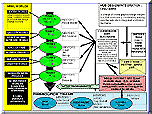
Click on the image to see how we organized the weekend.
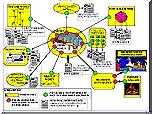
Click on the image to see how we organized the �story board�
From out of the vast experience and talent that made up the group a few individuals came forward to bring the planning process and a production methodology into focus for everyone. The veteran world builder Pascal Baudar, Creative Director of Cybertown advanced the project by building the first VRML draft of Electronic Cafe International. Pascal also espoused the necessity of story boarding of all the concepts that had been tossed into the hat, form point and click functionality and interactivity to wishful thinking -- this would insure we all had the same road map when we divided into task teams. The first concept maps/story boards were created and placed on the Internet for review by all the other members of the VRML users Group so that all could add changes and make notations leading to the next generation of story boards.
Celia and Pascal exchanged notes and proceeded to create a convergence of all the viable and not-so-viable ideas by emailing their collaboration to the entire group for comment. Checklists were passed around to determine of what had to be done for each world, story board, design, model, behaviors, prioritizing them to deciding which of them we were going to be able to accomplish realistically over the weekend. An aesthetic and technical "tips and tricks" list was discussed, and alas, testing the creations with different VRML viewers.
With the both PC and SGI platforms and different software tools for VRML worlds creation it was agreed form the onset that we would create a high-end VRML-ECI for the SGI environment and a web-based VRML-ECI world with textures/sound/etc., that would be as user friendly as possible to 28.8 modems and standard Pentiums. It was also agreed that creating a VRML 1.0 world for Mac users would be a nice touch. The main web-based world would be multi-user looking towards at OZ, Sony, and Blacksun. Portals to other VRML-ECI worlds and content would keep the size of the VRML-ECI "entry" world down to a palatable minimum. Use all objects, screens and devices in the VRML-ECI as portals to information, worlds, experiences, activities, etc., each module may also have portals to other modules and web-worlds. (SEE: "VRML-ECI Barn Raising Goals")
Teams were busy with getting out press releases, organizing catering for the two days, pursuing additional sponsors, and setting up workshop registration forms on the website.
With all the talent and technology being brought together for two days it was obvious that we were creating a valuable opportunity for a workshop for both pros and novices. In addition to performing the formidable task of the Barn Raising using different platforms (in two days), we would also be encountering compatibility issues in a way that would advance everyone's understanding of what is possible and where the limitations are at this moment in VRML time.
We would designate production teams for all of the tasks with a designated mentor for each team including different VRML world creation tools, creating JAVA scripts, VRML objects, custom avatars creation, texture mapping, or multi-user worlds, etc. Students could chose the production team of their choice and on the second day they could migrate from team to team. Still, each mentor and their team would be responsible for the completion of their assignments.
To achieve the entire vision of the project production teams and students would have to be assigned different tasks, so a wall size story board and "job board" was created. On the opening day, Celia oriented the students to the methodology and the detailed guidelines of the Barn Raising story board. The story board directed tasks to teams and the project specific documents those teams would need to complete their tasks. A foundation for aesthetic issues, design, creativity, color choice, etc. had already been established, but it was established as a guideline and not to inhibit the creativity of the various mentors and their students.
Each team had a portfolio including the Barn Raising story board and the various documents describing their component tasks, the audio, video, JPEG, etc., assets available to go with it, and who to see to acquire them. Dave Blackburn was the choice for overall production coordinator and to keep an ongoing inventory and give everyone status reports to keep us all on target. Each team had it's own coordinator to report back to the production coordinator.
| VRML WEEKEND | QUICKTIME VR | PLUG-INS | GOALS |
| PHOTO GALLERY | HOME | VRML 1.0 | VRML 2.0 | CREDITS |